
SLEEP TIPS · 5 min
The Microclimate of Better Sleep
Why airflow, textile breathability and room temperature shape sleep continuity.
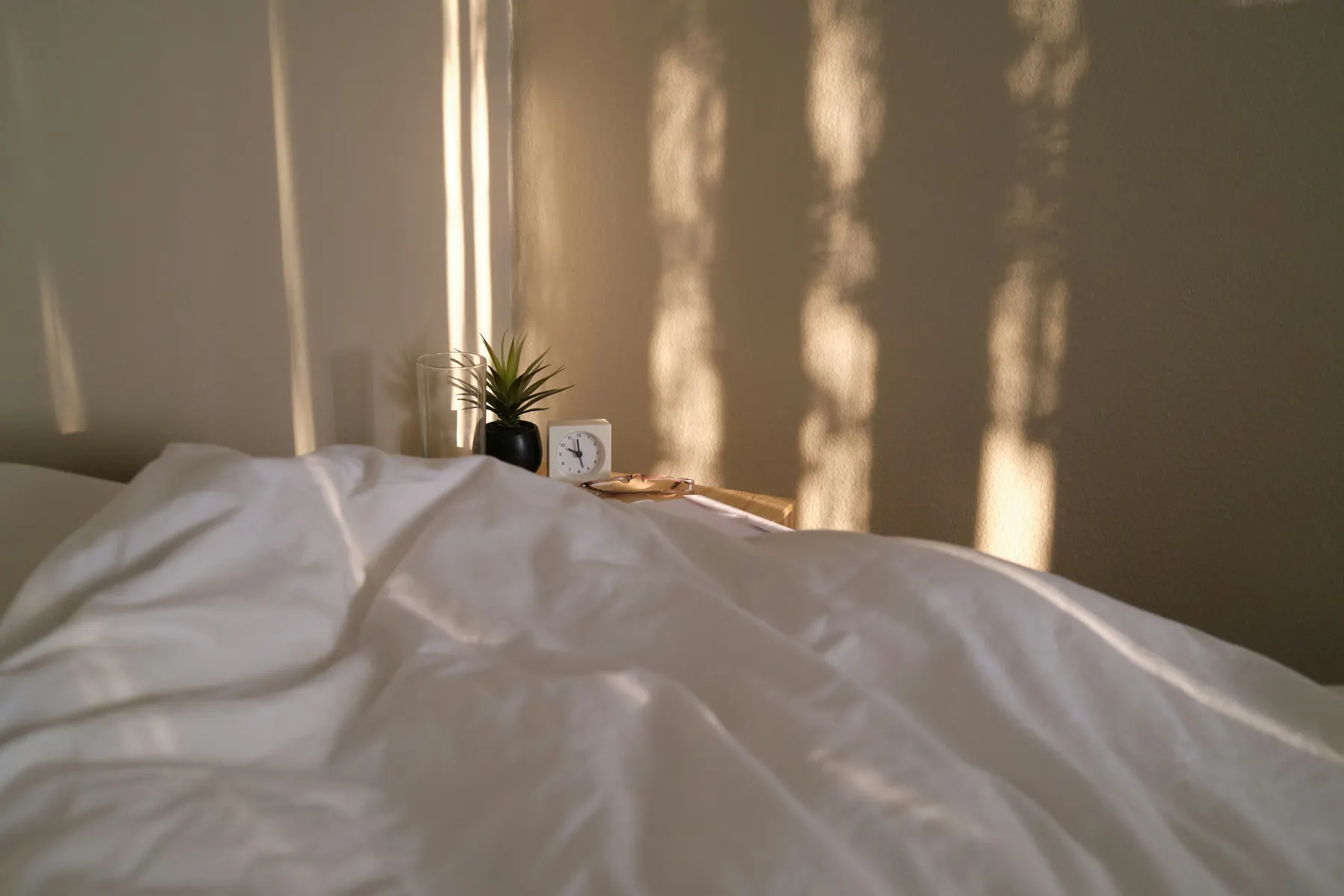
A Lahore summer tests a bed like few other places do. Sleeping cooler depends less on "ice-cool" labels than on three things you can control: the room, the sheets, and how the mattress is built.
Your bed has its own climate
The thin layer of air between your skin and the bedding normally stays at about 32 to 34°C during good sleep, with moderate humidity. When that pocket gets hotter or damper, you wake. Bedding helps a great deal in a cold room. In a hot room it only adds heat.
Why heat costs you deep sleep
To fall asleep, your core temperature has to drop, so the body starts shedding heat through the skin about two hours before bed. A hot, humid room blocks that. Studies find more waking, and less deep sleep and dream (REM) sleep, mostly in the first half of the night, when most deep sleep happens.
Humidity matters as much as temperature. A surface that feels cool to the touch but leaves you damp does not help. You need a bed that moves both heat and moisture away from the body.
Heat costs sleep everywhere. A study of about 7 million nights, recorded by wristbands in 68 countries, found that nights above 30°C cut sleep by just over 14 minutes on average. People adapted far less well to heat than to cold.
A realistic target for a Lahore bedroom
Many guides call 18°C the ideal bedroom temperature. That figure assumes you sleep under a duvet, and it is out of reach in most Lahore homes in summer. European heatwave advice is more practical: keep the bedroom below 25°C, and use fans where you can.
In Lahore, average night lows from June to August are about 25 to 27°C. May and June bring dry heat, and July and August bring monsoon humidity of around 70%. Walls and roofs give off stored heat after sunset, so a bedroom cooled only by a fan often stays warmer than the air outside.
A sensible setting is AC at 24 to 26°C with the ceiling fan on low. The fan helps sweat evaporate, so the room feels cooler than the thermostat reading. Each degree lower on the AC adds roughly 3% to its electricity use.
When the power goes
During load-shedding, the mattress and the sheets are the only cooling left. A few practical tips:
- Take a lukewarm shower before bed, not a hot one. In a hot room the body has nowhere to lose the extra heat.
- Keep curtains closed during the day, and open the windows once the air outside is cooler than inside.
- Swap the quilt for one light cotton sheet.
- In the humid monsoon weeks, air coolers work less well and add moisture to the room.
How the mattress is built matters more than the label
- Pocket spring and hybrid mattresses: air can move through the spring layer. Independent testing consistently finds them the coolest to sleep on.
- Latex: cooler than memory foam, because it does not hug the body as closely.
- Memory foam: moulds closely to the body, which is why it holds more heat.
- Gel-infused memory foam: feels cool when you lie down. On its own, independent testing finds it sleeps much like standard memory foam, so it works best over springs that let air move, under a breathable cover.
- Cooling covers and phase-change fabrics: promising in the lab, with little evidence yet over a full night.
If you sleep hot, start with a pocket spring mattress. Our Fresco O2 is designed for hot sleepers: a cool gel-infused memory foam layer under the quilt sits over 1,000 pocket cells, under breathable Oxygen Plus fabric. La Grande Pillow Top pairs breathable knitted fabric with air channels in its foam layers, so it does not trap heat. Whichever you choose, ask our team about the comfort layers on top, because a thick layer of standard memory foam holds more heat than a quilted or latex top.
Sheets and protectors
- Choose breathable cotton or linen sheets. As a general guide, a crisp percale weave breathes better than a glossy sateen, and polyester holds heat.
- Choose a breathable mattress protector over a vinyl or plastic-backed one, which can trap heat.
Who needs extra care
Heat affects older adults, young children and pregnant women most, and alcohol makes heat-related sleep problems worse. On the hottest nights, keep an eye on the people in your home who feel the heat most.
Sources
- Okamoto-Mizuno and Mizuno, Journal of Physiological Anthropology, 2012: effects of the thermal environment on sleep
- Okamoto, Mizuno and Okudaira, 1997: humidity and sleep on a ventilated mattress
- Minor et al., One Earth, 2022: rising temperatures and human sleep
- Altena et al., 2022: sleep advice for heatwaves (European Insomnia Network)
- Pakistan Meteorological Department: Lahore climate normals, 1991 to 2020
- Sleep Foundation: best temperature for sleep; whether gel memory foam sleeps cool; temperature-control testing
- Kräuchi et al., 2018: mattress surface and sleep temperature
When to seek specialist care
Sleep comfort guidance is educational and does not diagnose or treat a health condition. Persistent, severe or radiating pain, numbness, breathing disruption or unexplained sleep problems should be discussed with a qualified healthcare professional.
TAKE THE SLEEP ASSESSMENT →